As there were many advances in newsprint i have specifically looked at the major advancements being the printing press and electronic printing, being the change in paper to Internet. Before we had the Internet and the technology the only way to print and read a newspaper was from a printing press, in short terms it was a device that simply applied to an inked surface resting upon a specific print medium,which in this case was newsprint, this would then be transferred by the ink. The very first newspaper to come out in English was the London Gazette in 1666. However before all this, including the printing press the very first and earliest "predecessors of the newspaper" were Corantos, which was a small print that was only produced and sold when a issue or event happened that was important enough to be written. The very first successful and popular newspaper title was The Weekly News in 1622.

Another dramatic change in printing industry due to the advances in technology is the methods of communicating. Back in the beginning of news reporting it would take days or even weeks for news overseas to be published, leading people receiving late news. The reasons for the delay of news was the fact that it was incredibly time consuming as it took time for a hand written newsprint and copy to be transferred over seas. When technological changes increased so did the methods of communication, with the use of telegraphy, telephones and fax machines. This then of course resulted to instant and fast reports, which where received and sent of to be in the shops on sale the next morning. New and advanced communication methods enable journalists to report important issues and stories all over the world, and instead of sending letters etc for interviews, technology enabled you to use the Internet or phones. Due to the advances in technology journalist are able to transfer important information and stories with the use of portable and small equipment, such as sending files, images, texts and audio recordings. This of course will enable journalist in the industry to report breaking news as it happens, for example, the London Riots, new technology allowed you to post videos or photos onto the Internet, which will aware people of whats currently happening.
 The rise in the advances in technology in print has lead people to be able to access the news in many different ways, due to the increase of online newspaper and portable devices. Specific newspapers have created there own downloads and applications, enabling readers to view any article, videos or images from the newspaper on either the digital reader, iPhone or iPad. New and advanced, apps and online newspapers are constantly being improved and recreated making the news industry having to keep up with technological changesas audiences needs expect, want and use many different types of technology and forms of reading the newspaper. However i do think printed newspaper are beneficial, as they are a more in deph and quick way to read the news, also one thing that news prints allow you to do which online papers do not is that you can easily pick up a newspaper for around 50p or even a free paper and read it and then pass it on to someone else to read without worrying if your loose connection, battery dying or getting your iPhone or iPad wet or scratched. I feel that the industry and history or the newspaper will only be successful by constantly improving and accepting audience needs and the technological advances that have lead to readers wanting to access the news in a more sophisticated, entertaining and advanced manner and style.
How have sets changed in the soap serial?
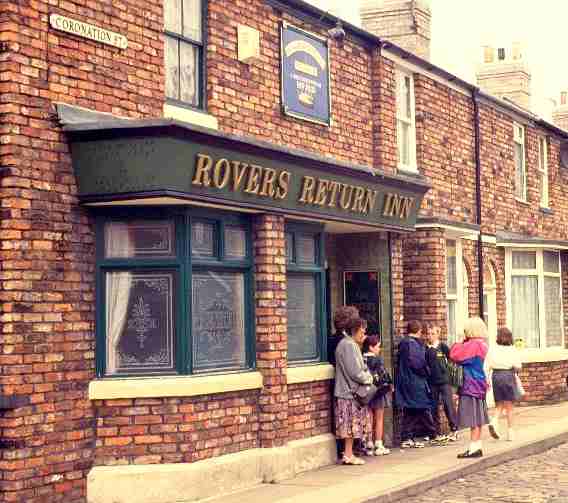 The sets in coronation street regular consist of several townhouses, exterior buildings including a row of terrace houses and sociable and local areas including a newsagents, a cafe, a general grocery shop and "The Rovers Return Inn"which is the main meeting place for the shows characters. From 1960 till 1968 the whole set of Coronation street including the exteriors and interiors was built, created and filmed in one of Granada Television Studio's. This one specifically in the central of Manchester were the sets were small and awkward, also they were reduced in scale 3/4. The reason why the set was created in a inside studio was because the infancy production techniques which didn't allow easy and quick recording and editing of sequences if they were to be filmed in a variety of different locations. The Granada television studio were split in two halves as it was not big enough for the entire street to be created and shot at once.Specific techniques were used such as painting pavements and cobbled street onto the studio floor to again add more of a realistic look to the set. Although episodes were filmed inside studios which were cramped and small dramatic and affective scenes were filmed successfully.
It was 1967 when Granada Television decided to build an outside set which was built on some old railway sidings near the studio.It was also the year when editing techniques improved enough to allow sequences to be filmed in separate exteriors and interior sets. The most noticeable and prominent change seen on screen was the natural light which gave more of a realistic look and atmosphere.The new set wasn't didn't have a dramatic difference to the previously used. The Street was constructed in brick, with roofs and back yards added later. The set was still reduced in scale and quite cramped and even though the pavements and cobbled street were now filmed on the new exterior was kept to a minimum because the cost of using film for exterior sequences were to high. It was 1982 when a new set was opened by Queen Elizabeth which had a full-size exterior street which was built in the Granada back lot As this was going to be permanent set, the houses were specifically constructed to give of a realistic and authentic look.This was achieved by
building the set from reclaimed roof slates and Salford brick and roof slates.The buildings are not completely built which most lack having interior walls. Parts such as the building interiors are used for the writers offices or store room for on screen costume and props. However, in preparation for the switch to High Definition, the chimneys are now made of real brick.In the following years specific features where added to the set like staircases which were added inside the doors of the houses. Also chimneys were now made from real brick as they were originally made from fibreglass as preparation for the switch to high definition.
It was1989 when Coronation street saw large development on the set. Due to the new executive producer, David Liddiment a factory,three new houses, two shop units and a garage were built on the site.This gave Coronation street a new modern feel which made the atmosphere and look of the set more realistic on screen. There was another update and extension to the exterior set in 1999. A new street, which consisted of three shops and two houses.It was confirmed in March 2009 that Coronation street would stay in the current Quay Street' site for now. However,due to the change of hands at ITV management it was announced in December 2010 that the move to 'Trafford Park' was to be followed.
How has the recording and broadcasting technology changed?
It was between 9 December 1960 and 3 March 1961 when Coronation Street was broadcast twice weekly, on Wednesday and Friday. Which during this time the Friday episode was broadcasted live, the last regular live episode to be broadcasted was on the 3rd February 1961.The Wednesday episode was pre-recorded 15 minutes after.The programme Coronation Street went fully networked on 6 March 1961 which then the broadcasting days changed to Monday and Wednesday. The series was transmitted and shown in black and white for most of the 1960s due to technical equipment and resources at the time.Coronation street was official first shown in colour on Wednesday 17th November 1969, this clip shows the very first colour opening credits for Coronation street.
The opening credits connote the class, style and economic state of coronation street at this particular time. the opening credits are incredibly dull, grim, musty and boring. The shots are extremely static and show no movement or feeling at all. The shots immediately go into showing the rows of tight houses,lined up next to each other which all look old and washed out with musky colours, also the houses are all identical which seems to be never ending. This connotes that the everyone is the same, there is no individuality that every ones "dull and boring" which isn't necessarily true but this is what the credits suggests. It also shows the economic state, with the run down roof tops which shows class and status, with there being no sense of glamour, life or colour. Also the fact that there is no one in the credits accept for a cat suggests there is no life to the street, no lively, exciting good-feeling atmosphere.
 There were a multiple of colour changes and in corrections between November to December 1969 on 'The Rovers Return' set without any on-screen explanation. It is possible that the reason for the drastic change in tones and shades on the
Coronation Street set was for the purpose of testing out the look of the costumes and sets using the new colour camera equipment. These
two episodes show notable differences in the scenery, particularly the shades used on walls of the Rovers Return Inn set. Before the first
colour transmitted episode on 17th November 1969, ep 928 technicians and designers tested out on videotaped in colour to see how costumes and sets appeared in colour. Which then they would make necessary adjustments so it would be suitable for colour television. It was from 22nd of March 2010 that Coronation street was produced in 1080/50i for transmission on HDTV platforms on ITV High definition. The first episode shown in this format was episode 7351 on 31st May 2010 with a new re-recorded theme tune and a new set of titles. Below is the new set of titles for Coronation street.
Episodes from 1960 till now are complete opposites in every way, just by the opening credits immediately gives 2011 Coronation Street a whole different atmosphere and outlook than before. Firstly the colour pallet is bright, romantic and vibrant which connotes Coronation street is a "happy and welcoming" place which gives a positive feeling to the audience. Camera movements used are tilting, panning, crane shots to show a variety of different parts of the street at different angles. Editing such as CGI (the pigeon, last shot) are used to connote the soap is more advanced and technical. Each shot had specific things in and out of focus to suggest important probs/parts, also every shot had edited in sunlight to again make the whole credits look brighter and happier. This is used to connote Corrie is a welcoming and friendly place.There are people in the 2011 opening credits compared to there being none in the 1969.
What has changed with HD?
It was from 22nd march where the very first high definition episode was broadcasted. ITV has made a multi-million pound investment in the latest technical facilities at the Manchester studio due to Coronation Street’s 50th birthday in December. The decision to move to HD was for the ITV viewers to enjoy a better than ever before viewing of their favourite soap, it was about time 'Corrie' entered the new era of HD. The ITV team upgraded to the latest high definition equipment such as cameras, editing and lighting facilities and production vehicles.Also some of the exterior sets had been upgraded to the HD standard. This gave a higher and better resolution which increased the amount of money intake and a bigger budget. It also consists the move to a state-of-the-art HD file based system from the original standard definition tape based system.
What impact has the HD format had on production?
Coronation street's producers plan was to still continue shooting in standard definition whilst at the same time testing the new file-based HD work flow and equipment. This consisted on converting two of the SD studios to the High Definition format and upgrading two OB vehicles for HD location shooting. There was also new HD camera technology which were also added in the form of six Ikegami 79EXs with Canon lenses. Coronation Street worked with the Avid Professional Services, this helped to complete projects that would have taken around 7 months in a much faster amount of time. Also it helped meet the show’s on air deadlines. Dave Williams, ITV Offline Editor reasons for working with Avid was "We’ve always worked on Avid because their systems are so fast, solid and user friendly. With Coronation Street, there is no room for foul ups"
The most key advantage of the makeover and turn to HD equipment and software was that it allows picture editors to gain faster access to material.This helped in production dramatically as it saved time and money which allowed script editors and directors to add comments straight to the camera rushes. Another key feature is that the Coronation street production team cannot afford to re shoot scenes or lose the rushes, so the fact that they can access material as soon as its been shot makes the editing and filming process much more easier.Which is critical for accelerated production pace soap like Coronation Street.
What is the impact for HD for Coronation Street?
The first night of Coronation Street's high-definition broadcasting proved it was an instant hit and success with the soaps viewers. There were more than 500,000 viewers watching the 9pm edition to the ITV1 HD channel on Monday 31 May. The ITV1 soap's first ever 9pm outing attracted 9.655 million viewers and a 38.2% share on the main network, with a further 509,000 (2.1%) on digital channel ITV1 HD.Coronation street going into High definition has impacted dramatically, with the a huge increase in the amount of viewers which would affect the popularity of the soap, the money intake and the budget. It has made Corrie more advanced than ever before.
How have the new grip technologies impacted on production?
 Tom Paterson of Forager Films Ltd was called onto the soap to provide crane shots from a rooftop where Jimmy Jibs would fear to tread.
There was a dramatic ending to a major character in the soap who was about to 'jump', the rooftop of the Granada building was the scene of a night shoot where Tom's HD Polecam proved its worth enabling the director to call for off roof shots and vertigo inducing moves from 4 stories high in the air. It was the first time a Polecam has been used on "Coronation Street" which has been running since the early Sixties. Now it is shot on P2 High Definition at 100Mbps using Ikegami cameras the Polecam's, the Toshiba camera was able to compliment the other pictures and provide intense and clear shots from beyond the roof line as well as craning moves to add drama to the scene. It also creates a strong vertigo and uneasy feeling which gives the audience the feeling of being up there on the roof. This adds more of a dramatic affect on the viewers and adds more realism to the soap.
What technological changes are in store for production in the future?In 2012/13 ITV will move there Manchester base to MediaCityUK at Salford Quays.Which will consist of a brand new high-tech production centre for Coronation Street. Also they are building a new bespoke production and studio centre on a 7.7 acre site at Trafford Wharf. This mean the sale for Corries existing production base.The Granada Studio's will also be updating up to new facilities and equipment. It also give opportunities to actors and writers living outside the southeast.
building the set from reclaimed roof slates and Salford brick and roof slates.The buildings are not completely built which most lack having interior walls. Parts such as the building interiors are used for the writers offices or store room for on screen costume and props. However, in preparation for the switch to High Definition, the chimneys are now made of real brick.In the following years specific features where added to the set like staircases which were added inside the doors of the houses. Also chimneys were now made from real brick as they were originally made from fibreglass as preparation for the switch to high definition.
It was1989 when Coronation street saw large development on the set. Due to the new executive producer, David Liddiment a factory,three new houses, two shop units and a garage were built on the site.This gave Coronation street a new modern feel which made the atmosphere and look of the set more realistic on screen. There was another update and extension to the exterior set in 1999. A new street, which consisted of three shops and two houses.It was confirmed in March 2009 that Coronation street would stay in the current Quay Street' site for now. However,due to the change of hands at ITV management it was announced in December 2010 that the move to 'Trafford Park' was to be followed.
How has the recording and broadcasting technology changed?
It was between 9 December 1960 and 3 March 1961 when Coronation Street was broadcast twice weekly, on Wednesday and Friday. Which during this time the Friday episode was broadcasted live, the last regular live episode to be broadcasted was on the 3rd February 1961.The Wednesday episode was pre-recorded 15 minutes after.The programme Coronation Street went fully networked on 6 March 1961 which then the broadcasting days changed to Monday and Wednesday. The series was transmitted and shown in black and white for most of the 1960s due to technical equipment and resources at the time.Coronation street was official first shown in colour on Wednesday 17th November 1969, this clip shows the very first colour opening credits for Coronation street.
The opening credits connote the class, style and economic state of coronation street at this particular time. the opening credits are incredibly dull, grim, musty and boring. The shots are extremely static and show no movement or feeling at all. The shots immediately go into showing the rows of tight houses,lined up next to each other which all look old and washed out with musky colours, also the houses are all identical which seems to be never ending. This connotes that the everyone is the same, there is no individuality that every ones "dull and boring" which isn't necessarily true but this is what the credits suggests. It also shows the economic state, with the run down roof tops which shows class and status, with there being no sense of glamour, life or colour. Also the fact that there is no one in the credits accept for a cat suggests there is no life to the street, no lively, exciting good-feeling atmosphere.

Coronation Street set was for the purpose of testing out the look of the costumes and sets using the new colour camera equipment. These
two episodes show notable differences in the scenery, particularly the shades used on walls of the Rovers Return Inn set. Before the first
colour transmitted episode on 17th November 1969, ep 928 technicians and designers tested out on videotaped in colour to see how costumes and sets appeared in colour. Which then they would make necessary adjustments so it would be suitable for colour television. It was from 22nd of March 2010 that Coronation street was produced in 1080/50i for transmission on HDTV platforms on ITV High definition. The first episode shown in this format was episode 7351 on 31st May 2010 with a new re-recorded theme tune and a new set of titles. Below is the new set of titles for Coronation street.
What has changed with HD?
It was from 22nd march where the very first high definition episode was broadcasted. ITV has made a multi-million pound investment in the latest technical facilities at the Manchester studio due to Coronation Street’s 50th birthday in December. The decision to move to HD was for the ITV viewers to enjoy a better than ever before viewing of their favourite soap, it was about time 'Corrie' entered the new era of HD. The ITV team upgraded to the latest high definition equipment such as cameras, editing and lighting facilities and production vehicles.Also some of the exterior sets had been upgraded to the HD standard. This gave a higher and better resolution which increased the amount of money intake and a bigger budget. It also consists the move to a state-of-the-art HD file based system from the original standard definition tape based system.
What impact has the HD format had on production?
Coronation street's producers plan was to still continue shooting in standard definition whilst at the same time testing the new file-based HD work flow and equipment. This consisted on converting two of the SD studios to the High Definition format and upgrading two OB vehicles for HD location shooting. There was also new HD camera technology which were also added in the form of six Ikegami 79EXs with Canon lenses. Coronation Street worked with the Avid Professional Services, this helped to complete projects that would have taken around 7 months in a much faster amount of time. Also it helped meet the show’s on air deadlines. Dave Williams, ITV Offline Editor reasons for working with Avid was "We’ve always worked on Avid because their systems are so fast, solid and user friendly. With Coronation Street, there is no room for foul ups"
The most key advantage of the makeover and turn to HD equipment and software was that it allows picture editors to gain faster access to material.This helped in production dramatically as it saved time and money which allowed script editors and directors to add comments straight to the camera rushes. Another key feature is that the Coronation street production team cannot afford to re shoot scenes or lose the rushes, so the fact that they can access material as soon as its been shot makes the editing and filming process much more easier.Which is critical for accelerated production pace soap like Coronation Street.
What is the impact for HD for Coronation Street?
The first night of Coronation Street's high-definition broadcasting proved it was an instant hit and success with the soaps viewers. There were more than 500,000 viewers watching the 9pm edition to the ITV1 HD channel on Monday 31 May. The ITV1 soap's first ever 9pm outing attracted 9.655 million viewers and a 38.2% share on the main network, with a further 509,000 (2.1%) on digital channel ITV1 HD.Coronation street going into High definition has impacted dramatically, with the a huge increase in the amount of viewers which would affect the popularity of the soap, the money intake and the budget. It has made Corrie more advanced than ever before.
How have the new grip technologies impacted on production?
 Tom Paterson of Forager Films Ltd was called onto the soap to provide crane shots from a rooftop where Jimmy Jibs would fear to tread.
There was a dramatic ending to a major character in the soap who was about to 'jump', the rooftop of the Granada building was the scene of a night shoot where Tom's HD Polecam proved its worth enabling the director to call for off roof shots and vertigo inducing moves from 4 stories high in the air. It was the first time a Polecam has been used on "Coronation Street" which has been running since the early Sixties. Now it is shot on P2 High Definition at 100Mbps using Ikegami cameras the Polecam's, the Toshiba camera was able to compliment the other pictures and provide intense and clear shots from beyond the roof line as well as craning moves to add drama to the scene. It also creates a strong vertigo and uneasy feeling which gives the audience the feeling of being up there on the roof. This adds more of a dramatic affect on the viewers and adds more realism to the soap.
What technological changes are in store for production in the future?In 2012/13 ITV will move there Manchester base to MediaCityUK at Salford Quays.Which will consist of a brand new high-tech production centre for Coronation Street. Also they are building a new bespoke production and studio centre on a 7.7 acre site at Trafford Wharf. This mean the sale for Corries existing production base.The Granada Studio's will also be updating up to new facilities and equipment. It also give opportunities to actors and writers living outside the southeast.

No comments:
Post a Comment